Before the next peck.
Red tint changes the visual contrast of red cues. Optical distortion changes visual detail. The objective is to reduce the stimulus to attack another bird.
CHICKEN LENSES BY ODI
The pecking order has a cost.
We look at it a little differently.
Red-tinted contact lenses designed around one idea: change what a hen sees, and you can change how the flock behaves.
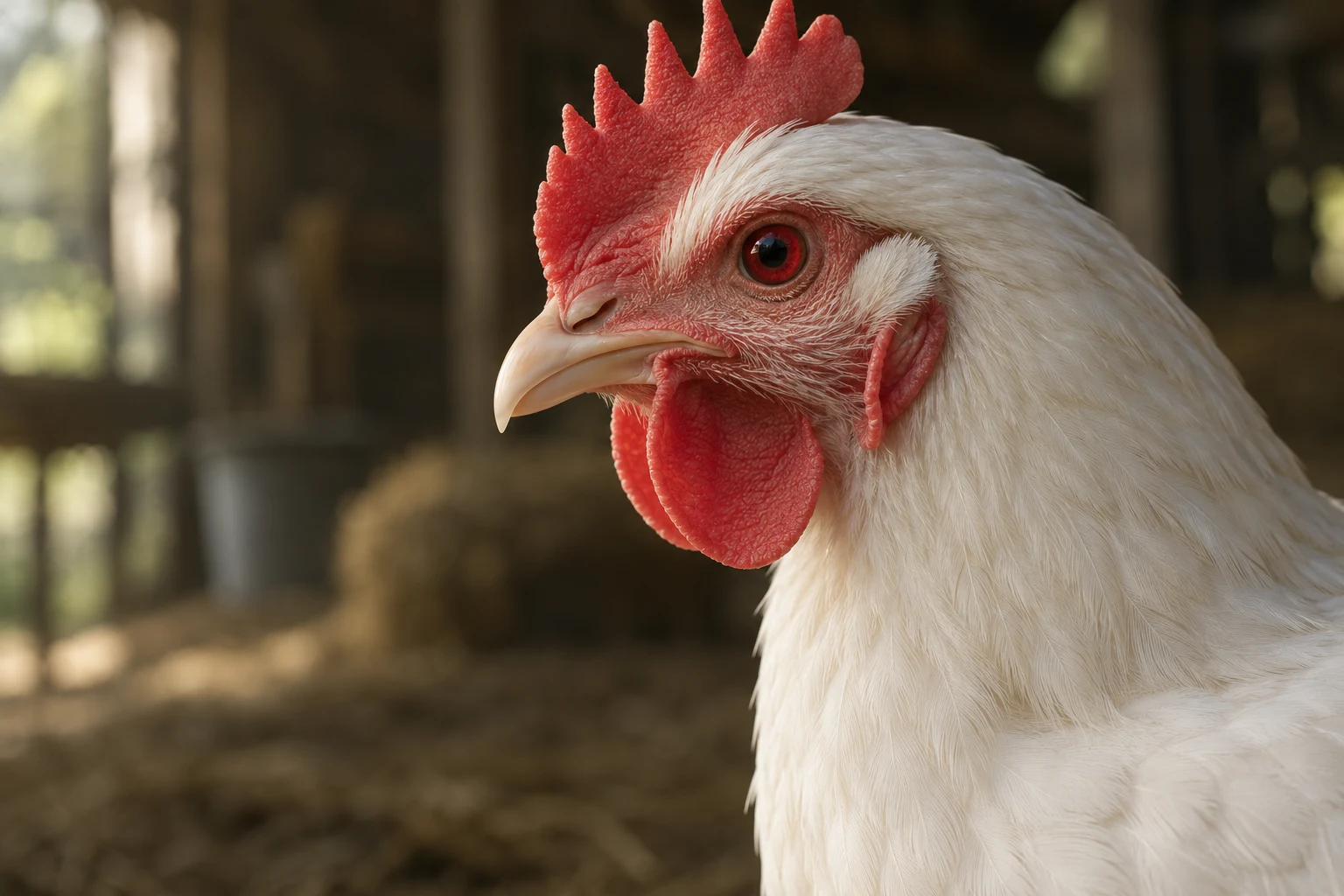
THE PROBLEM IN PLAIN SIGHT
An injured bird is only the most visible cost of an aggressive flock.
Lost laying days, uneven access to feed, additional handling and the time spent managing injured birds all belong in the same calculation. A henhouse can look productive while quietly losing margin.
Traditional beak trimming addresses the bird’s ability to inflict damage. Chicken Lenses approach the problem through vision: an optical intervention intended to interrupt the cues behind aggressive pecking.
Red tint changes the visual contrast of red cues. Optical distortion changes visual detail. The objective is to reduce the stimulus to attack another bird.
Track saleable eggs per hen housed, injury removals and mortality together. An improvement in one measure should not conceal a decline in another.
Measure feed disappearance against egg output. Less feed used is meaningful only when body condition and production remain acceptable.
THE ORIGINAL CHICKEN LENS
Purpose-built poultry optics.
Two lenses per bird. A different approach to an old management problem.
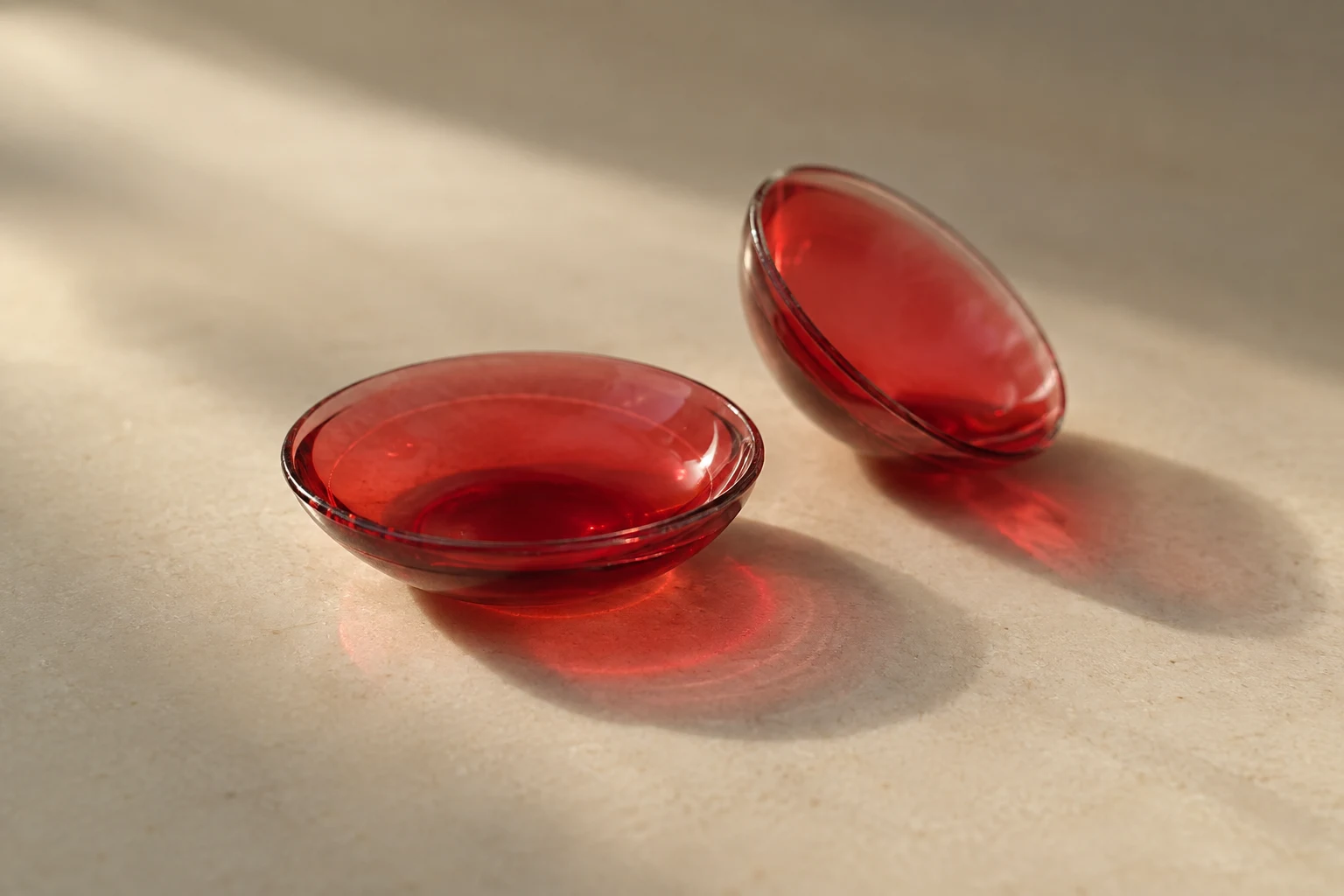
WHAT THE LENS CHANGES
Ordinary contact lenses correct eyesight. The original Chicken Lens concept deliberately alters it. Red tint and optical distortion are the central features, not incidental effects.
THE PRINCIPLE Change the visual input. Measure the behavioral response.
THE OPTICAL DISTORTION RANGE
Red is the foundation of the range. Our color-development series explores more specialized flock behaviors, with red-center configurations for each program.
Pecking management
The original lens. Designed around the relationship between visual cues and inter-bird aggression in laying flocks.
STANDARD FLOCK PROGRAMMating behavior
A breeding-flock concept focused on social interaction. The red-center configuration explores a more passive mating profile.
BREEDER SERIESTemperament & vocalization
A quieter behavioral profile, historically described as “melancholy.” The red-center configuration focuses on reduced vocalization.
TEMPERAMENT SERIESFlock organization
A spatial-behavior concept exploring how birds organize within a house, including horizontal and vertical grouping profiles.
ORGANIZATION SERIESColor-development programs are separate from the Red flock program. Pricing and feed calculations below refer to Red lenses only.
THE ECONOMICS OF A PAIR
A fraction of an ounce matters when it is repeated across a house, every day. Test a feed-saving assumption against the lens cost before counting any other benefit.
+$1,266
Illustrative balance over 365 days
Break-even requires 3.6 g saved per bird per day over this period.
Gross feed savings = birds × grams saved per bird per day × days ÷ 907,184.74 grams per US short ton × feed cost per short ton.
Lens cost = birds × the applicable program price per pair. Balance = gross feed savings − lens cost. Break-even days are rounded up; displayed dollars are rounded to the nearest dollar.
A complete flock budget should use the actual bird population over time and add installation disruption, retained productivity, replacement lenses and support beyond the included period. Do not count the same production benefit twice under both mortality and egg revenue.
FLOCK PROGRAMS
Red lens pairs, installation and on-site team training form the base of each program. Select a flock size to explore its feed economics.
SMALL FLOCK
$0.75/ pair
GROWING FLOCK
$0.70/ pair
COMMERCIAL FLOCK
$0.65/ pair
INTEGRATED OPERATION
$0.50/ pair
USD per pair. One pair equips one bird. Program illustrations exclude freight and taxes. Response times refer to initial service contact, not an on-site arrival.
FROM THE OFFICE TO THE HENHOUSE
The purchase price is easy to compare. The real test is what happens through a laying cycle, under the conditions of a particular house.
Our field approach begins with a baseline and ends with a decision. Between the two: matched comparisons, consistent records and a clear account of the work involved.
Read the commercial approachESTABLISH THE BASELINE
Record flock age and strain, housing arrangement, lighting, feed delivery, injury removals and recent egg output. Define the measures and review dates before changing the routine.
PLAN A CONTROLLED COMPARISON
Compare similar groups under equivalent management. Account for season, age and ration changes. Agree on veterinary oversight, handling responsibilities and stopping criteria before any field work.
FOLLOW THE FULL PICTURE
Review eye condition and lens retention alongside feeding, drinking, body condition and egg production. Record additional labor and every removal; an average can hide a problem in one group.
MAKE THE COMMERCIAL DECISION
Reconcile feed, saleable eggs, losses and support costs. A rollout decision requires acceptable flock condition and repeatable economics, not a single favorable week.
THE COMMERCIAL APPROACH
An unfamiliar product needs more than a box and a price. It needs a route into the farm, a trained team and a reason for the producer to look again.
Start with a serviceable cluster of commercial egg producers. Farm density determines travel time, training coverage and the cost of a return visit. A wide territory is not an advantage if the technical team cannot cover it.
The farm manager needs to understand handling and daily observation. The owner needs a cost per bird and a credible payback. The same visit should address both, with assumptions visible and responsibilities agreed.
Coordinate shipment quantities, flock schedules, installation capacity and replacement stock. For cross-border supply, resolve import requirements and landed costs before setting the delivery date.
Red-eyed hens invite questions. Explain what the lens is intended to do, what is being measured and how flock condition is reviewed. Public confidence belongs in the operating plan, alongside production costs.
PRACTICAL QUESTIONS
From lens color to the cost per bird.
Red tint is intended to change how red visual cues appear to the bird, including the contrast associated with blood. It is part of the original concept alongside distortion of visual detail. Color alone does not establish that a product is effective or suitable for a particular flock.
Chicken Lenses sit at the eye rather than on a frame attached to the beak. The historical design is specific to avian anatomy, including the inner eyelid. Human contact lenses are not a substitute.
The concept was developed as an alternative approach to managing damaging pecking. Beak trimming changes the beak; the lens changes visual input. Suitability cannot be inferred from the concept alone, and neither approach removes the need to manage housing, nutrition and flock condition.
A pair means two lenses for one bird. The four Red programs include installation and on-site training, with different support periods and initial response targets. The calculator applies the price to every bird in the entered flock; it is not a stepped or marginal-volume calculation.
No. It is a feed-only scenario. The default 4 grams of daily savings is an editable assumption, not a trial result or a claim of expected performance. A complete model would include flock changes, productivity, handling, replacements, transport and other operating costs.
Eye condition, lens retention, access to feed and water, body condition, mortality, injury removals and saleable eggs all matter. A reduction in visible pecking is not sufficient evidence of an acceptable overall result.
No. Each belongs to a separate behavioral development concept. The mating, temperament and organization profiles should not be folded into the Red program’s pricing or economic calculation.
The program model budgets one new pair per bird. It assumes no resale, sterilization or reuse value. Do not build a purchasing case around recovering lenses from a previous flock.
A DIFFERENT POINT OF VIEW